Moore Insights
Articles and research from Moore Cooperative.
Articles and research from Moore Cooperative.
Pay Equity Is A Data Problem, Not A PR Statement
Companies across industries claim they value fair pay. Many have begun posting salary ranges and conducting audits. Yet the gaps keep appearing. According to federal labor data, women working full time in the United States earned about 84 percent of what men earned in 2023, measured on a weekly basis. The number has barely shifted in nearly twenty years.
During that same period, pay transparency laws expanded rapidly. Today, laws requiring salary ranges or pay disclosures apply to an estimated 40 percent of the United States workforce.
This raises a simple question. If companies are more aware and regulations are growing, why do inequities persist?
The answer points to a deeper issue. Pay equity is not a communications challenge or a brand posture. It is a data infrastructure problem. Companies with unclear roles, inconsistent job levels, mixed data sources, and manual benchmarking cannot create fair practices no matter how strong their intent may be.
When the inputs are weak, the outcomes follow.
Why PayEquity.ai Exists and Why We Made it Public
At Moore Cooperative, we saw this pattern repeatedly in our compensation consulting. The challenges we solved for clients are almost never philosophical. They are operational. Teams struggled to create clear, consistent, verifiable salary ranges because they lack strong inputs at the start of each pay decision.
To solve that gap, we built PayEquity.ai first as an internal tool. It helped us generate salary ranges for clients quickly and with high confidence. It supported audits and compensation studies. It allowed us to validate job language, ensure alignment with verified market data, and produce defensible outputs at scale.
Now, we have made it public-facing.
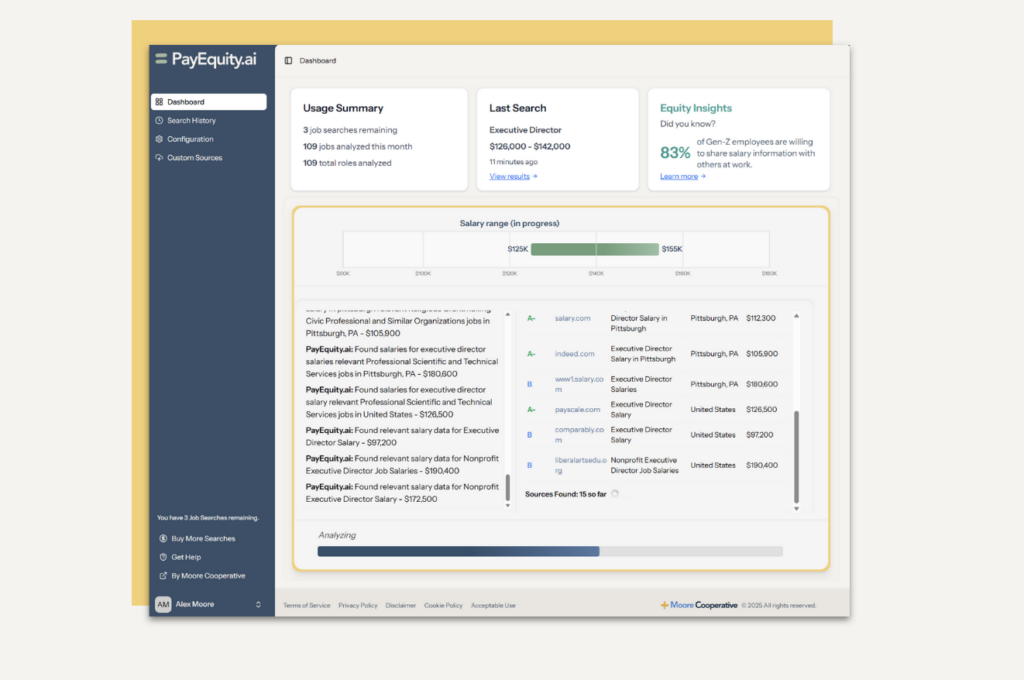
Anyone can paste a job description into PayEquity.ai, choose a location, and receive a data backed salary range in minutes. The output includes a confidence score and clear justification text. It streamlines the most error prone part of compensation work.
For organizations that need broader coverage, PayEquity.ai Enterprise adds unlimited searches, the ability to ingest proprietary and HRIS data, and reporting tools for salary structures and pay equity analysis.
The product is built for companies that want fair pay to be a system, not a rescue operation.
The Hidden Sources of Pay Inequity
Pay inequity rarely begins with a single decision. It accumulates over time from small inconsistencies that compound. These inconsistencies often appear in places that leadership does not inspect closely.
Common drivers include:
- Vague or outdated job descriptions
- Roles with identical titles but different scopes
- Market data pulled from unverified online sources
- Historic salary decisions with no documented rationale
- One-off exceptions negotiated during hiring that never reconnect to the compensation structure
These issues shape salaries long before an audit takes place. SHRM reports that 61 percent of organizations say they conduct pay equity audits, yet only 54 percent review pay at least once a year. Annual or regular audits cannot overcome daily inconsistencies.
Another study found that employers who regularly review equity and implement consistent compensation practices achieve an 8 percent higher return on equity than their peers. Clean data reduces risk and improves decision quality. Better pay systems are not only fair: they support stronger business outcomes.
Better Lense for Understanding Pay Equity
Traditional pay equity efforts follow a predictable cycle. Teams gather data, clean it by hand, run a comparison, identify gaps, and make adjustments. The process repeats when time allows or when regulatory pressure demands it.
These traditional approaches treat equity as a correction, not a system. They focus on outcomes instead of the origins of those outcomes.
A more effective approach begins with a different question: instead of asking where gaps exist, ask what inputs created the gaps.
When organizations shift toward input quality, they stop reacting to inequities and begin preventing them. The focus moves to role clarity, consistent job architecture, verified market data, and structured decision logic.
PayEquity.ai is designed to support that shift by generating clean, defensible ranges at the moment decisions are made.
What PayEquity.ai Delivers
PayEquity.ai produces salary ranges grounded in verified market compensation data. It evaluates job descriptions, identifies the underlying job family, accounts for location, and generates a recommended range with a confidence score. From the public version, users receive:
- A clear salary range that reflects market conditions
- A confidence score that signals whether the job description is specific enough
- Justification text that outlines the reasoning behind the range
- Outputs that can be used directly with candidates or internal stakeholders
- From PayEquity.ai Enterprise, companies can access:
- Unlimited searches
- HRIS and salary survey integrations
- Batch analysis for many roles
- Reporting for structure development and pay equity identification
The result is consistent input quality at scale. The system that supports pay decisions becomes predictable and transparent.
How PayEquity.ai Changes the Conversation
Fair pay is often discussed as a moral or compliance issue. It is both, but it is also an operational capability. Strong systems change the questions leaders ask and data provides evidence to answer them.
Old Questions
- What do we need to pay to be competitive?
- Can we afford to publish our ranges?
- How large is the gap this year?
Better Questions
- What data sits beneath every salary decision?
- Can we show how our ranges were built?
- Are our decisions consistent across managers, locations, and time?
From Client Tool to Public Product
PayEquity.ai began as a tool for our consulting work. It supported compensation studies, audits, and structure design for clients who needed reliable, defensible data.
We built it to make our own work more consistent.
We released it publicly because every employer deserves the same quality of tools.
The public version is designed for teams that need fast, credible answers for each new job. The Enterprise version is built for organizations that want compensation to be a structured, repeatable system.
Fair pay depends on strong inputs. PayEquity.ai exists to deliver those inputs in a way that is clear, scalable, and ready for every decision